Some anti-gun people think owning a gun is a sign of some kind of mental abnormality. According to General Social Survey data, gun owners are not more likely to have ever suffered from some sort of mental health problem.

Some anti-gun people think owning a gun is a sign of some kind of mental abnormality. According to General Social Survey data, gun owners are not more likely to have ever suffered from some sort of mental health problem.
Face-to-face interviews were conducted with 36,309 respondents in the 2012-2013 National Epidemiologic Survey on Alcohol and Related Conditions–III. I was surprised that this study published the percent of each racial/ethnic group that has antisocial personality disorder (ASPD). Having ASPD is closely related to being a psychopath.
Natives have the highest rate -- 11.9%. Blacks are second with 5.3%. Asians are at the bottom with 1.9%. So the Native rate is 6.3 times that of Asians.
The heritability of ASPD is around 50%.
This CDC table shows that the Native homicide rate is high (the victim rate is a proxy for the offender rate) but the Black rate is higher. Why would that be if ASPD is more common among Natives?

It could be that Blacks tend to live in urban settings, while Natives are more likely to be rural. Urban life seems to be conducive to crime. Cities enable a critical mass of antisocial individuals to come together and form gangs that produce more crime than would be committed by solitary individuals.
The high Native rate seems consistent with Harpending and Cochran hypothesis that groups with weak histories of agrarian life, which selects for submissiveness, will tend to be more disagreeable.
I challenge people not on the right when the data don't support what they're claiming, so I ought to be fair and report when the data do back them up. Matt Iglesias and Richard Hanania recently claimed on Twitter that Trump supporters are fatter than (woke) Democrats. The table below (GSS data) shows that the average Trump voter was about 6 pounds heavier than the typical Hillary supporter in 2016.
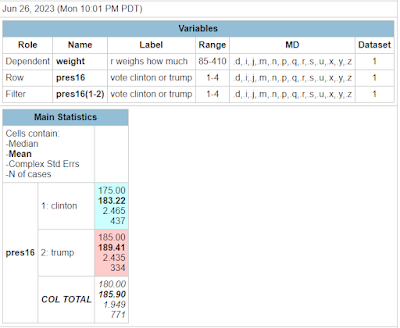
UPDATE: While lying in bed this morning, I realized I needed to look at the sexes separately since women were more likely to vote for Hillary, and they weigh less. I see that a commenter was thinking the same:
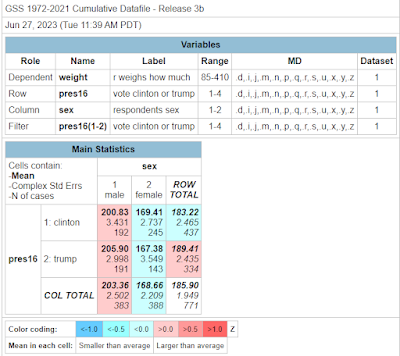
You can see that while male Trump supporters weigh more, female Trump supporters weigh less than Hillary voters. Maybe later I can take height differences into account.
UPDATE: Not much height difference:

Centrists like Richard Hanania go on endlessly about how dumb MAGA is compared to Democrats. These types are flat wrong, but everyone assumes they're right based on data showing lower IQs for conservatives. Here are the mean IQ scores for those who voted for Trump vs. Hillary. The mean is slightly higher for Trump voters. At least get your facts straight before mocking people.

I like to occasionally check the Rolling Stone list of the greatest singers of all time to look for updates and to get a sense of trends. Did you know that Blacks have gotten much better at singing since the last list was made? They now occupy all ten of the top ten slots, if we count biracial Mariah Carey. Despite a US population size that is roughly five times larger than that of Blacks, Whites simply cannot crack the top ten anymore. I suspect the answer for why Blacks are so much better is that St. George Floyd from his lofty palace in Heaven has blessed Blacks with voices even superior to those they enjoyed before Floyd's death.

Are Whites happier if they value their ethnic identity? General Social Survey participants were asked, "How important is your ethnic group membership to your sense of who you are?" About 39% of Whites who answered "very important" are very happy compared to around 30% of the other three levels of ethnic importance.
These numbers are consistent with the theory that individuals are happier if they feel a strong connection to their race or ethnicity. The connection gives them a sense of meaning and value that goes beyond the isolated individual.
What is interesting is that this theory is typically applied to non-Whites, and most advocates of this
perspective do not want Whites to identify strongly with their race. What is even more interesting is
that racial pride does not even appear to work for Blacks. Look at the numbers below. Blacks who
place the least value on racial identification are the happiest. (A larger sample would be nice.)
And other races? The sample is too small, but it looks like the racially proud might be happier.The stereotype of the proud White is that he is mentally disturbed and thus likely to be unhappy.
GSS data suggest the opposite.
According to a new Harris poll, 86% of Republicans and even 60% of Democrats believe sex education for young children under 10 should be left to the parents. This is a winning issue for the GOP even if most parents feel their personal rights are not being violated (left panel).
People who are racially mixed often say they feel like they are in a racial "no man's land," neither one race nor the other. Are they less happy than people of only one race? Let's look at Black-Whites first (2021 GSS data):


The same pattern is found for those who say they are both White and Native American: a mean of 1.82 versus 1.97 for Whites and 1.91 for Natives.

Finally, I merged Chinese, Japanese, and Koreans together and found that the White-NE Asian group tended to be less happy (1.78) than either Whites (1.97) or NE Asians (2.01).
So with the exception of Black-Whites, people of mixed race tend to be a little less happy than those of one race. There is some support here for the contention that having a mixed identity is not conducive to happiness.
Since 2015, I've spent most of my time commenting on Twitter, knowing that one day I would get the axe. That day came last week, and I was told the suspension is permanent. I have no idea what the problem is, but I do know that even if the ban is not forever, I don't want to invest time and energy into something that can end at any moment. So I plan to return to my old ways of posting data analyses here. I'll save my posts in case Google finally bans me. I will focus a little less on GSS data since I'm running out of uncovered topics, but I will continue to post items the left considers blasphemous. It's not fun otherwise.
Some anti-gun people think owning a gun is a sign of some kind of mental abnormality. According to General Social Survey data, gun owners ...


